SysML 2 DSL Reference
SysML 2 is kUML’s second modelling language — a domain-specific language for systems engineering defined by OMG SysML v2.0. While the UML DSL focuses on software structure and behaviour, SysML 2 is purpose-built for modelling physical and cyber-physical systems: requirements, functional breakdown, parametric constraints, and executable state behaviour.
The SysML 2 DSL entry point is sysml2Model:
sysml2Model("SystemName") {
    // diagram builders go here
}
Every diagram builder is also usable at top level without the sysml2Model wrapper — the
wrapper is only needed when a single script contains multiple SysML 2 diagrams.
Diagram types at a glance
| Abbreviation | Full name | Builder | Use it for |
|---|---|---|---|
BDD |
Block Definition Diagram |
|
Structural decomposition: blocks, value properties, ports, part/reference associations. |
IBD |
Internal Block Diagram |
|
Internal wiring: parts within a block, connectors between ports, item flows. |
UC |
Use Case Diagram |
|
Actor goals: system actors, use cases, include/extend relationships. |
REQ |
Requirements Diagram |
|
Stakeholder requirements: requirements, derives, satisfies, verifies, contains links. |
STM |
State Machine Diagram |
|
Executable discrete behaviour: states, transitions, trigger/guard/action triples. |
ACT |
Activity Diagram |
|
Executable workflow: actions, decisions, forks/joins, item flows, object flows. |
SEQ |
Sequence Diagram |
|
Time-ordered interaction between blocks: lifelines, messages, combined fragments. |
PAR |
Parametric Diagram |
|
Constraint properties: parameters, equations, numerical constraints. |
Block Definition Diagrams (BDD)
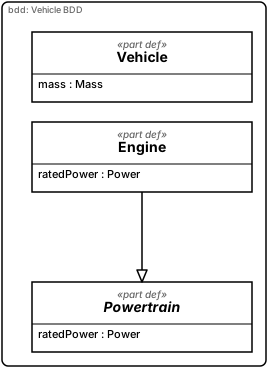
BDD is the SysML 2 analogue of the UML class diagram. The central classifier is block.
Rendered live below (vault source:
03 Bereiche/kUML/Beispiele/03 SysML 2 BDD – Hybrid Vehicle.md):
import dev.kuml.sysml2.dsl.sysml2Model

sysml2Model(name = "VehicleSystem") {
    val massType = attributeDef(name = "Mass")
    val powerType = attributeDef(name = "Power")

    // Abstract base definition — cannot be instantiated directly
    val powertrain = partDef(name = "Powertrain", isAbstract = true) {
        attribute(name = "ratedPower", typeId = powerType.id)
    }

    val vehicle = partDef(name = "Vehicle") {
        attribute(name = "mass", typeId = massType.id)
    }

    // Specialisation: Engine is a concrete Powertrain flavour
    val engine = partDef(name = "Engine", specializesId = powertrain.id) {
        attribute(name = "ratedPower", typeId = powerType.id)
    }

    bdd(name = "Vehicle BDD") {
        include(definition = powertrain)
        include(definition = vehicle)
        include(definition = engine)
    }
}
Key BDD elements:
| Element | Notes |
|---|---|
|
The top-level SysML 2 classifier. Supports |
|
A typed scalar or structured value. |
|
A typed part (composition by reference to another block type). |
|
|
|
Whole/part relationship. Renders as filled diamond. |
|
Non-ownership association. Block args or string names. |
Internal Block Diagrams (IBD)
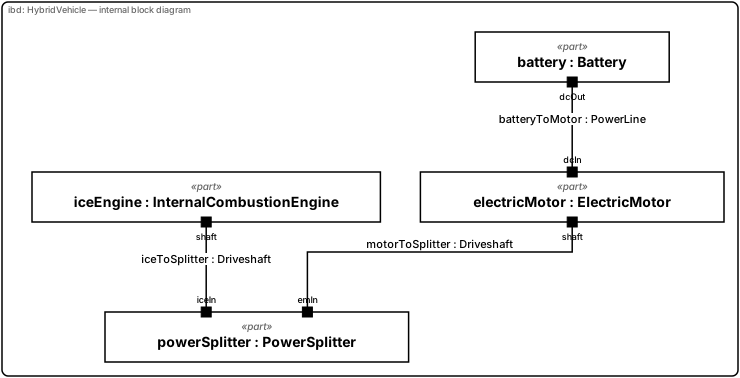
IBD shows the internal wiring of a single block context: parts, ports, and connectors
between them. Rendered live below (vault source:
03 Bereiche/kUML/Beispiele/27 SysML 2 IBD – Hybrid Vehicle Wiring.md):
import dev.kuml.sysml2.dsl.sysml2Model

sysml2Model(name = "HybridVehicleSystem") {
    val powerLine  = connectionDef(name = "PowerLine")
    val driveshaft = connectionDef(name = "Driveshaft")

    val dcPort    = portDef(name = "DcPort")
    val shaftPort = portDef(name = "ShaftPort")

    val battery = partDef(name = "Battery") {
        port(name = "dcOut", typeId = dcPort.id)
    }
    val electricMotor = partDef(name = "ElectricMotor") {
        port(name = "dcIn",  typeId = dcPort.id)
        port(name = "shaft", typeId = shaftPort.id)
    }
    val iceEngine = partDef(name = "InternalCombustionEngine") {
        port(name = "shaft", typeId = shaftPort.id)
    }
    val powerSplitter = partDef(name = "PowerSplitter") {
        port(name = "emIn",  typeId = shaftPort.id)
        port(name = "iceIn", typeId = shaftPort.id)
    }

    val hybrid = partDef(name = "HybridVehicle") {
        part(name = "battery",       typeId = battery.id)
        part(name = "electricMotor", typeId = electricMotor.id)
        part(name = "iceEngine",     typeId = iceEngine.id)
        part(name = "powerSplitter", typeId = powerSplitter.id)

        connect(
            name = "batteryToMotor",
            typeId = powerLine.id,
            sourceEndId = "HybridVehicle::battery::dcOut",
            targetEndId = "HybridVehicle::electricMotor::dcIn",
        )
        connect(
            name = "motorToSplitter",
            typeId = driveshaft.id,
            sourceEndId = "HybridVehicle::electricMotor::shaft",
            targetEndId = "HybridVehicle::powerSplitter::emIn",
        )
        connect(
            name = "iceToSplitter",
            typeId = driveshaft.id,
            sourceEndId = "HybridVehicle::iceEngine::shaft",
            targetEndId = "HybridVehicle::powerSplitter::iceIn",
        )
    }

    ibd(name = "HybridVehicle — internal block diagram", owner = hybrid)
}
Use Case Diagrams (UC)
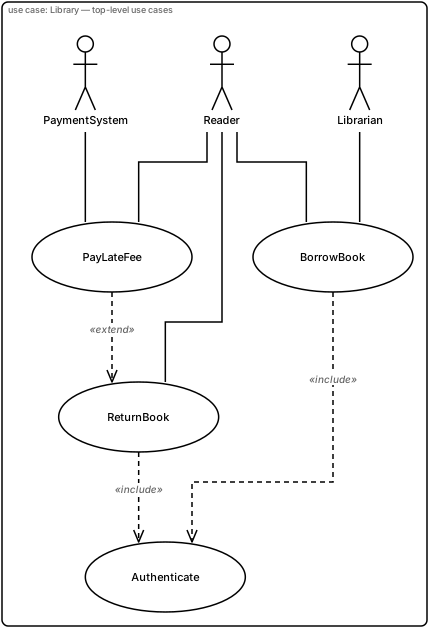
SysML 2 use case syntax mirrors UML use case: actors, use cases, include/extend
relationships. Rendered live below (vault source:
03 Bereiche/kUML/Beispiele/05 SysML 2 UC – Library System.md):
import dev.kuml.sysml2.dsl.sysml2Model

sysml2Model(name = "LibrarySystem") {
    val reader = actorDef(name = "Reader")
    val librarian = actorDef(name = "Librarian")
    val paymentSystem = actorDef(name = "PaymentSystem")

    val borrowBook = useCaseDef(name = "BorrowBook")
    val returnBook = useCaseDef(name = "ReturnBook")
    val payLateFee = useCaseDef(name = "PayLateFee")
    val authenticate = useCaseDef(name = "Authenticate")

    ucDiagram(name = "Library — top-level use cases") {
        include(definition = reader)
        include(definition = librarian)
        include(definition = paymentSystem)
        include(definition = borrowBook)
        include(definition = returnBook)
        include(definition = payLateFee)
        include(definition = authenticate)

        association(actor = reader, useCase = borrowBook)
        association(actor = reader, useCase = returnBook)
        association(actor = reader, useCase = payLateFee)
        association(actor = librarian, useCase = borrowBook)
        association(actor = paymentSystem, useCase = payLateFee)

        // «include»: target is always executed as part of source
        include(source = borrowBook, target = authenticate)
        include(source = returnBook, target = authenticate)

        // «extend»: target's behaviour is optionally extended by source
        extend(source = payLateFee, target = returnBook)
    }
}
Requirements Diagrams (REQ)
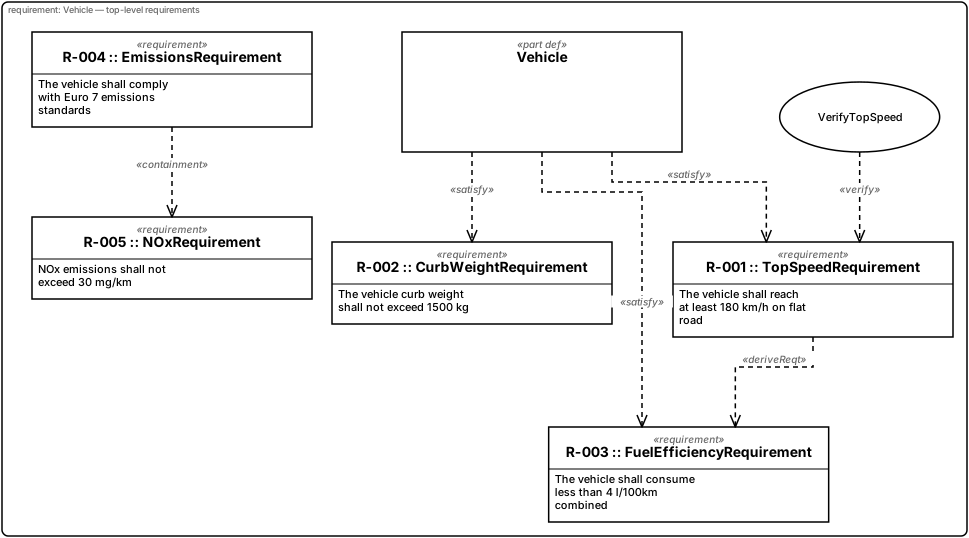
Requirements diagrams trace stakeholder needs through derivation, satisfaction,
verification, and containment. Rendered live below (vault source:
03 Bereiche/kUML/Beispiele/08 SysML 2 REQ – Vehicle Requirements.md):
import dev.kuml.sysml2.dsl.sysml2Model

sysml2Model(name = "VehicleRequirements") {
    val topSpeed = requirementDef(
        name = "TopSpeedRequirement",
        reqId = "R-001",
        text = "The vehicle shall reach at least 180 km/h on flat road",
        subject = "Vehicle",
    )
    val curbWeight = requirementDef(
        name = "CurbWeightRequirement",
        reqId = "R-002",
        text = "The vehicle curb weight shall not exceed 1500 kg",
        subject = "Vehicle",
    )
    val fuelEfficiency = requirementDef(
        name = "FuelEfficiencyRequirement",
        reqId = "R-003",
        text = "The vehicle shall consume less than 4 l/100km combined",
        subject = "Vehicle",
    )
    val emissions = requirementDef(
        name = "EmissionsRequirement",
        reqId = "R-004",
        text = "The vehicle shall comply with Euro 7 emissions standards",
        subject = "Vehicle",
    )
    val nox = requirementDef(
        name = "NOxRequirement",
        reqId = "R-005",
        text = "NOx emissions shall not exceed 30 mg/km",
        subject = "Vehicle",
    )

    val vehicle = partDef(name = "Vehicle")
    val verifyTopSpeed = useCaseDef(name = "VerifyTopSpeed")

    reqDiagram(name = "Vehicle — top-level requirements") {
        include(definition = topSpeed)
        include(definition = curbWeight)
        include(definition = fuelEfficiency)
        include(definition = emissions)
        include(definition = nox)
        include(definition = vehicle)
        include(definition = verifyTopSpeed)

        satisfy(source = vehicle, requirement = topSpeed)
        satisfy(source = vehicle, requirement = curbWeight)
        satisfy(source = vehicle, requirement = fuelEfficiency)

        verify(source = verifyTopSpeed, requirement = topSpeed)

        // Endgeschwindigkeit vs. Verbrauch ist ein klassischer Trade-off
        derive(source = topSpeed, target = fuelEfficiency)

        contains(parent = emissions, child = nox)
    }
}
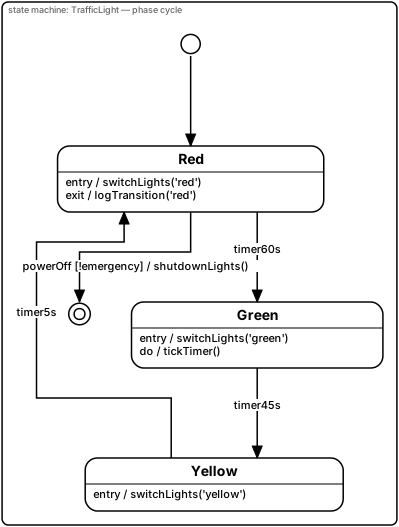
State Machine Diagrams (STM)
STM is the primary entry point for executable behaviour in SysML 2. kUML implements
SysML 2 state machines on top of the same runtime as UML state machines — kuml simulate
works for both.
Rendered live below (vault source:
03 Bereiche/kUML/Beispiele/04 SysML 2 STM – Traffic Light.md):
import dev.kuml.sysml2.dsl.sysml2Model

sysml2Model(name = "TrafficLight") {
    val initial = stateDef(name = "Initial", isInitial = true)
    val red = stateDef(
        name = "Red",
        entryAction = "switchLights('red')",
        exitAction = "logTransition('red')",
    )
    val green = stateDef(
        name = "Green",
        entryAction = "switchLights('green')",
        doAction = "tickTimer()",
    )
    val yellow = stateDef(
        name = "Yellow",
        entryAction = "switchLights('yellow')",
    )
    val off = stateDef(name = "Off", isFinal = true)

    transition(name = "init", source = initial, target = red)
    transition(name = "redToGreen", source = red, target = green, trigger = "timer60s")
    transition(name = "greenToYellow", source = green, target = yellow, trigger = "timer45s")
    transition(name = "yellowToRed", source = yellow, target = red, trigger = "timer5s")
    transition(
        name = "powerOff",
        source = red,
        target = off,
        trigger = "powerOff",
        guard = "!emergency",
        effect = "shutdownLights()",
    )

    stmDiagram(name = "TrafficLight — phase cycle") {
        include(state = initial)
        include(state = red)
        include(state = green)
        include(state = yellow)
        include(state = off)
    }
}
Run the machine with a JSON events file:
kuml simulate thermostat.kuml.kts --events thermostat-events.jsonSee State-Machine Simulation for the full events/trace format, golden trace verification, and interactive REPL mode.
kuml simulate supports both UML stateDiagram { stateMachine { … } } and
SysML 2 sysml2Model { stateDef / transition } syntaxes. The underlying runtime is shared.
|
Activity Diagrams (ACT)
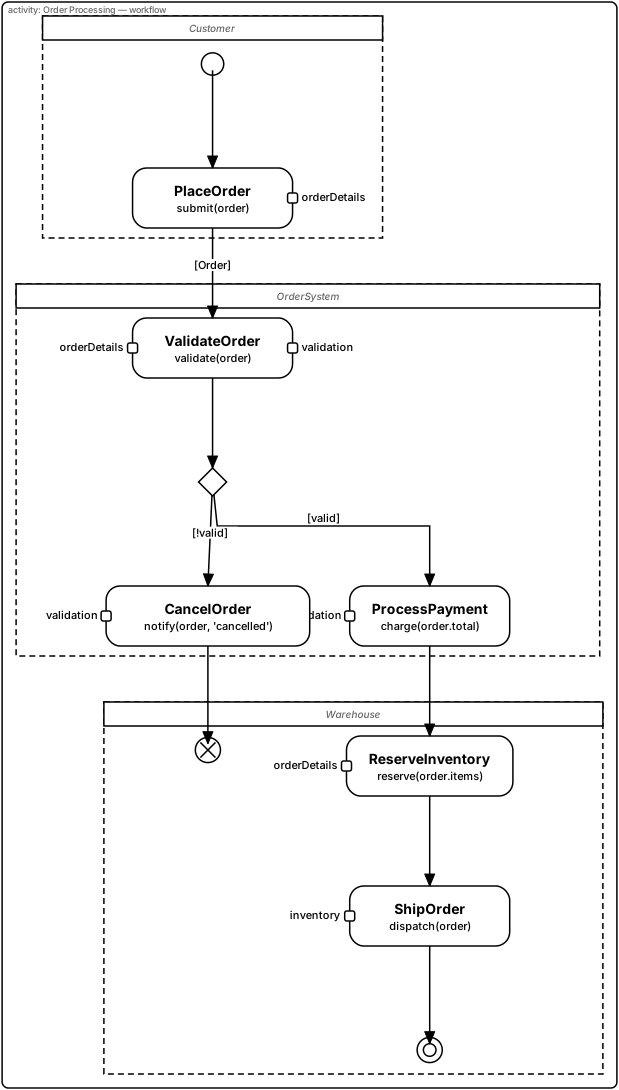
Activity diagrams in SysML 2 model executable workflows with actions, control flow, and parallel branches.
Rendered live below (vault source:
03 Bereiche/kUML/Beispiele/07 SysML 2 ACT – Order Processing.md) — swimlanes
(partitions), typed pins, a decision node, and an object flow carrying a typed order:
import dev.kuml.sysml2.ActionPin
import dev.kuml.sysml2.PinDirection
import dev.kuml.sysml2.dsl.sysml2Model

sysml2Model(name = "OrderProcessing") {
    partDef(name = "Customer")
    partDef(name = "OrderSystem")
    partDef(name = "Warehouse")

    val customerLane = activityPartition(name = "Customer", represents = "Customer")
    val orderSysLane = activityPartition(name = "OrderSystem", represents = "OrderSystem")
    val warehouseLane = activityPartition(name = "Warehouse", represents = "Warehouse")

    val initial = initialNode(partition = customerLane)
    val placeOrder = actionDef(
        name = "PlaceOrder",
        action = "submit(order)",
        partition = customerLane,
        pins = listOf(ActionPin(name = "orderDetails", typeId = "Order", direction = PinDirection.Output)),
    )

    val validate = actionDef(
        name = "ValidateOrder",
        action = "validate(order)",
        partition = orderSysLane,
        pins = listOf(
            ActionPin(name = "orderDetails", typeId = "Order", direction = PinDirection.Input),
            ActionPin(name = "validation", typeId = "Bool", direction = PinDirection.Output),
        ),
    )
    val decide = decisionNode(name = "valid?", partition = orderSysLane)
    val pay = actionDef(
        name = "ProcessPayment",
        action = "charge(order.total)",
        partition = orderSysLane,
        pins = listOf(ActionPin(name = "validation", typeId = "Bool", direction = PinDirection.Input)),
    )
    val cancel = actionDef(
        name = "CancelOrder",
        action = "notify(order, 'cancelled')",
        partition = orderSysLane,
        pins = listOf(ActionPin(name = "validation", typeId = "Bool", direction = PinDirection.Input)),
    )

    val reserve = actionDef(
        name = "ReserveInventory",
        action = "reserve(order.items)",
        partition = warehouseLane,
        pins = listOf(ActionPin(name = "orderDetails", typeId = "Order", direction = PinDirection.Input)),
    )
    val ship = actionDef(
        name = "ShipOrder",
        action = "dispatch(order)",
        partition = warehouseLane,
        pins = listOf(ActionPin(name = "inventory", typeId = "Inventory", direction = PinDirection.Input)),
    )
    val finalN = finalNode(partition = warehouseLane)
    val flowFinal = flowFinalNode(partition = warehouseLane)

    controlFlow(name = "start", source = initial, target = placeOrder)
    controlFlow(name = "validated", source = validate, target = decide)
    controlFlow(name = "yes", source = decide, target = pay, guard = "valid")
    controlFlow(name = "payToReserve", source = pay, target = reserve)
    controlFlow(name = "reserveToShip", source = reserve, target = ship)
    controlFlow(name = "end", source = ship, target = finalN)
    controlFlow(name = "no", source = decide, target = cancel, guard = "!valid")
    controlFlow(name = "cancelEnd", source = cancel, target = flowFinal)

    objectFlow(name = "carryOrder", source = placeOrder, target = validate, objectType = "Order")

    actDiagram(name = "Order Processing — workflow") {
        include(node = initial)
        include(node = placeOrder)
        include(node = validate)
        include(node = decide)
        include(node = pay)
        include(node = cancel)
        include(node = reserve)
        include(node = ship)
        include(node = finalN)
        include(node = flowFinal)
    }
}
Activity diagrams are also runnable via kuml simulate. The trace contains ForkSplit,
JoinReached, ActionExecuted, and ActivityTerminated entries.
kuml simulate currently supports STM and ACT diagram types for SysML 2 models.
Other diagram types (BDD, IBD, REQ, SEQ, PAR) produce renderable output only.
|
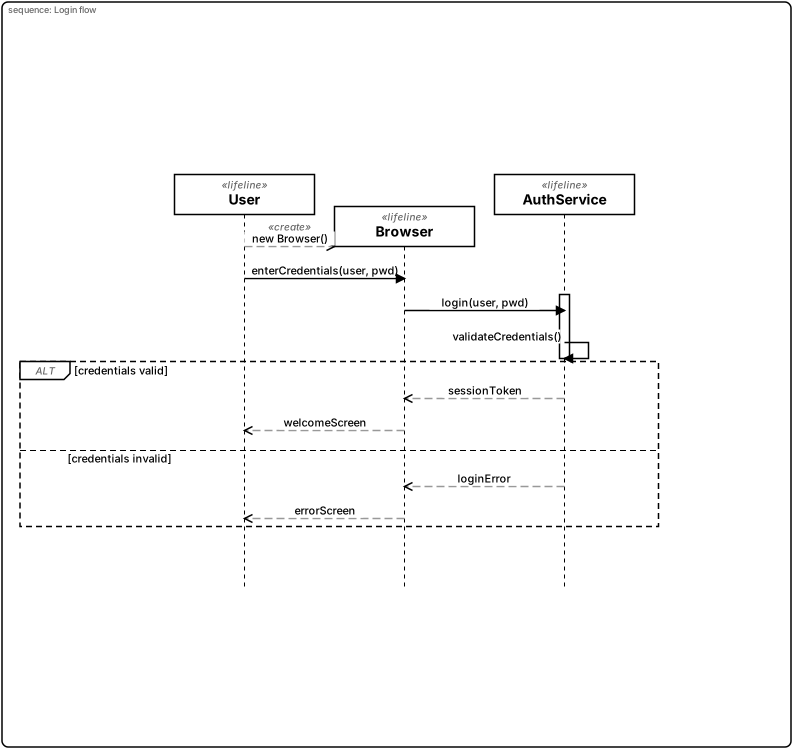
Sequence Diagrams (SEQ)
Time-ordered interaction between blocks: lifelines, messages, execution
specifications, and combined fragments (alt, loop, …). Rendered live below
(vault source: 03 Bereiche/kUML/Beispiele/06 SysML 2 SEQ – Login Flow.md):
import dev.kuml.sysml2.CombinedFragmentOperand
import dev.kuml.sysml2.CombinedFragmentOperator
import dev.kuml.sysml2.MessageKind
import dev.kuml.sysml2.dsl.sysml2Model

sysml2Model(name = "LoginFlow") {
    val user = lifelineDef(name = "User")
    val browser = lifelineDef(name = "Browser")
    val authService = lifelineDef(name = "AuthService")

    message(label = "new Browser()", source = user, target = browser, seqNo = 0, kind = MessageKind.Create)
    message(label = "enterCredentials(user, pwd)", source = user, target = browser, seqNo = 1, kind = MessageKind.Sync)
    message(label = "login(user, pwd)", source = browser, target = authService, seqNo = 2, kind = MessageKind.Sync)
    message(label = "validateCredentials()", source = authService, target = authService, seqNo = 3, kind = MessageKind.Sync)
    message(label = "sessionToken", source = authService, target = browser, seqNo = 4, kind = MessageKind.Reply)
    message(label = "welcomeScreen", source = browser, target = user, seqNo = 5, kind = MessageKind.Reply)
    message(label = "loginError", source = authService, target = browser, seqNo = 6, kind = MessageKind.Reply)
    message(label = "errorScreen", source = browser, target = user, seqNo = 7, kind = MessageKind.Reply)

    executionSpec(name = "authServiceActive", lifeline = authService, startSeqNo = 2, endSeqNo = 3)

    combinedFragment(
        name = "credentialsCheck",
        operator = CombinedFragmentOperator.Alt,
        operands = listOf(
            CombinedFragmentOperand(guard = "credentials valid", startSeqNo = 4, endSeqNo = 5),
            CombinedFragmentOperand(guard = "credentials invalid", startSeqNo = 6, endSeqNo = 7),
        ),
    )

    seqDiagram(name = "Login flow") {
        include(lifeline = user)
        include(lifeline = browser)
        include(lifeline = authService)
    }
}
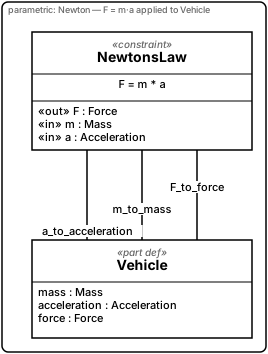
Parametric Diagrams (PAR)
Parametric diagrams connect constraint properties to value properties, expressing numerical relationships.
Rendered live below (vault source:
03 Bereiche/kUML/Beispiele/28 SysML 2 PAR – Newton.md):
import dev.kuml.sysml2.ConstraintParameter
import dev.kuml.sysml2.ConstraintParameterDirection
import dev.kuml.sysml2.dsl.sysml2Model

sysml2Model(name = "NewtonModel") {
    attributeDef(name = "Mass")
    attributeDef(name = "Acceleration")
    attributeDef(name = "Force")

    val newton = constraintDef(
        name = "NewtonsLaw",
        expression = "F = m * a",
        parameters = listOf(
            ConstraintParameter(name = "F", typeId = "Force",        direction = ConstraintParameterDirection.Out),
            ConstraintParameter(name = "m", typeId = "Mass",         direction = ConstraintParameterDirection.In),
            ConstraintParameter(name = "a", typeId = "Acceleration", direction = ConstraintParameterDirection.In),
        ),
    )

    val vehicle = partDef(name = "Vehicle") {
        attribute(name = "mass",         typeId = "Mass")
        attribute(name = "acceleration", typeId = "Acceleration")
        attribute(name = "force",        typeId = "Force")
    }

    bind(name = "F_to_force",         source = "NewtonsLaw::F", target = "Vehicle::force")
    bind(name = "m_to_mass",          source = "NewtonsLaw::m", target = "Vehicle::mass")
    bind(name = "a_to_acceleration",  source = "NewtonsLaw::a", target = "Vehicle::acceleration")

    parDiagram(name = "Newton — F = m·a applied to Vehicle") {
        include(definition = newton)
        include(definition = vehicle)
    }
}
M2M transforms from UML to SysML 2
kuml transform supports model-to-model (M2M) transformations. As of V2.x, UML models
can be used as a source for SysML 2 transformer targets:
kuml transform uml-order-domain.kuml.kts \
    --transformer uml-to-sysml2-requirements \
    --output sysml2-req-view.kuml.kts
List all available transformers:
kuml transform --list-transformers
The SysML 2 transformer targets were introduced in V2.x. Earlier CLI versions only
supported code generation via kuml generate. See CLI Reference for the
full transform subcommand documentation.
|
Cross-references
-
State-Machine Simulation — events format, trace format, golden traces, interactive REPL
-
CLI Reference —
kuml simulate,kuml transform,kuml rendersubcommands -
UML DSL Reference — the parallel UML 2.x language